Blogs & Articles / Property Valuation is More Than Just Comparing Nearby Sales

One of the most common questions people ask about property valuation is: “If my neighbour’s unit sold for $1.5 million, doesn’t that mean my property is worth $1.5 million too?”
Not necessarily. While recent transactions are an important part of the valuation process, they are only one piece of the puzzle.
Valuers often begin by analysing comparable sales which are properties that are similar in terms of location, size, tenure and property type.
However, no two properties are exactly alike. Even within the same development, factors such as floor level, unit facing, view, layout, condition and renovations can influence how buyers perceive value.
For example, a higher-floor unit with an unblocked view may attract stronger demand than a lower-floor unit facing a busy road, despite having the same floor area.
Valuation is not simply about matching a property to the nearest transaction. Valuers also consider the circumstances surrounding each sale, prevailing market conditions and whether a transaction is truly comparable to the property being assessed. A transaction that occurred several months ago during a different market environment may not carry the same relevance today.
This is where professional judgment comes in. Property valuation involves analysing market evidence, understanding buyer behaviour and assessing the unique characteristics of each property to arrive at a supportable opinion of value.
Recent sales provide valuable guidance, but valuation is ultimately about interpreting the market, not just reading transaction records.

Written By
Leroy is currently a Year 3 student progressing into Year 4 at the National University of Singapore, pursuing a degree in Business Administration (Real Estate).

Reviewed By
Wei Han is a Valuer at CKS Property Consultants, graduated from the University of Reading Malaysia with a BSc in Real Estate with Honours, where he built a strong foundation in property valuation, real estate economics and facilities operations.

Copyright © 2024 CKS Property Consultants Pte Ltd

Originally published on mortgageplus.
Blogs & Articles / Are Larger Units Really Better Value?
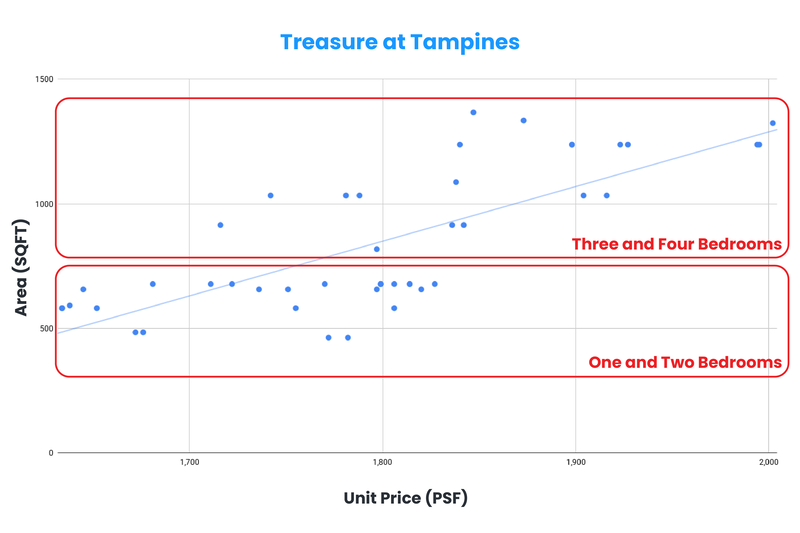
Would you spend $100 to get a 15% discount, or $200 to get a 20% discount? Most people assume that buying more means paying less per unit – the classic “bulk discount” effect – and property has traditionally worked the same way. Smaller units usually come with a higher price per square foot (PSF), while larger units tend to have a lower PSF.
However, we are seeing a shift in the market, and it is becoming more prevalent that larger homes do not equal lower PSF. Why is this happening? The answer lies in the shift in price quantum and buyer behaviour.
No, we are not talking about Yeezy’s QNTM sneakers, but how buyers evaluate a property based on its overall affordability. In property, “quantum” refers to the total purchase price of a home, not just its PSF. For example, Unit A is priced at $1,000,000 with a size of 500 sqft, making its PSF $2,000. On the other hand, Unit B is 1,000 spft, at a price of $1,700,000, making its PSF $1,700.
Even though Unit B has a lower PSF, the actual financial commitment is higher, and this is where buyer behaviour changes.
Traditionally, before ABSD was introduced, smaller units attracted investors because of lower entry prices. They could purchase two smaller units at the price of one bigger unit, even if they were paying a higher premium on a PSF basis.
Recent transactions show how this shift is playing out in actual pricing. Some larger homes are holding comparable, or even stronger, PSF values, reflecting how buyer priorities have changed in today’s market.
The old assumption that larger units have lower PSF may no longer hold true. With more buyers prioritising space, larger homes are seeing stronger demand than before. Instead of looking at PSF alone, buyers should evaluate the total financial commitment, future flexibility, and whether the property truly fits their long-term plans. In today’s market, the better purchase is not always the one with the lower PSF – it is the one that makes the most financial sense for you.
Written By
Yi Yang is a valuer at CKS with experience across property valuation, property sales and real-estate related client work.
Copyright © 2024 CKS Property Consultants Pte Ltd
Blogs & Articles / What Actually Affects A Property’s Value?
You’ve probably heard the phrase “location, location, location” when it comes to property.
While location is certainly important, it is far from the only factor that affects a property’s value.
In reality, property valuation involves considering a combination of factors that influence how buyers perceive and compare properties in the market.
Location remains a key consideration. Proximity to MRT stations, schools, amenities and employment centres can influence demand and, in turn, value.
However, factors within the property itself can also make a difference. These may include the size of the property, floor level, unit orientation, view, condition and overall layout.
For example, two units within the same development may have identical floor areas but different values because one enjoys an unblocked view while the other faces a busy road.
Property values are also influenced by broader market conditions.
Recent transaction prices, supply and demand dynamics, interest rate movements and overall market sentiment can all affect how properties are valued at a particular point in time.
This is why a property’s value may change over the years even when no physical changes have been made to it.
Property valuation is ultimately about understanding how the market views a property relative to other comparable properties.
While no single factor determines value on its own, it is the combination of location, property characteristics and market evidence that helps shape a property’s value.
Understanding these factors can help homeowners, buyers and investors make more informed property decisions in an ever-evolving market.
Written By
Leroy is currently a Year 3 student progressing into Year 4 at the National University of Singapore, pursuing a degree in Business Administration (Real Estate).
Reviewed By
Wei Han is a Valuer at CKS Property Consultants, graduated from the University of Reading Malaysia with a BSc in Real Estate with Honours, where he built a strong foundation in property valuation, real estate economics and facilities operations.
Copyright © 2024 CKS Property Consultants Pte Ltd
Blogs & Articles / Why Are Asking Price and Valuation Not the Same Thing?
One common misconception in the property market is that a property’s asking price is automatically equal to its valuation. In reality, the two can sometimes differ significantly.
An asking price is ultimately set by the seller and may reflect expectations, market sentiment or personal considerations. In competitive markets, sellers may price properties higher based on perceived demand or recent headline transactions nearby.
A valuation, on the other hand, is an independent professional assessment of a property’s market value at an as-is basis, with no future regards.
Professional valuers assess factors such as recent comparable transactions, property condition, floor level, location and prevailing market conditions. The objective is to arrive at a supportable estimate of market value based on available evidence.
This is particularly important in mortgage financing, as banks typically rely on valuation reports to determine loan amounts rather than the seller’s asking price.
For example, if a buyer agrees to purchase a property above its valuation, the difference will need to be covered using additional cash upfront.
Understanding each distinction and the differences between asking price and market value can help buyers make more informed financial decisions and better assess affordability before committing to a purchase.
As market conditions continue to evolve, professional valuation remains an important part of supporting informed and sustainable property transactions.
Written By
Leroy is currently a Year 3 student progressing into Year 4 at the National University of Singapore, pursuing a degree in Business Administration (Real Estate).
Reviewed By
Yi Yang is a valuer at CKS with experience across property valuation, property sales and real-estate related client work.
Copyright © 2024 CKS Property Consultants Pte Ltd

Blogs & Articles / Why two similar properties can have different values
Two properties within the same development may appear almost identical at first glance: similar size, layout and even located on the same floor. However, in practice, their valuations can sometimes differ more than what homeowners expect.
This is because property valuation involves more than simply comparing floor area or past transaction prices.
Professional valuers assess a range of factors when determining a property’s value. These may include floor level, unit facing, orientation, renovation condition, surrounding environment and overall market demand at the time of assessment.
For example, a unit with an unblocked view and better natural lighting may attract stronger buyer interest than another unit facing a busy road or carpark. Renovation quality and overall condition may also influence how buyers perceive value in the market.
Timing can also play an important role. Property markets are constantly evolving, and valuations are supported by comparable sales evidence available at the point of assessment. Changes in market sentiment, financing conditions or nearby developments may therefore affect value over time.
This is why valuation is not simply about identifying a “similar” property nearby. Professional judgment remains important in analysing both market evidence and the unique characteristics of each property.
As Singapore’s property market continues to evolve, understanding these differences can help homeowners and buyers make more informed property and financing decisions.
Written By
Leroy is currently a Year 3 student progressing into Year 4 at the National University of Singapore, pursuing a degree in Business Administration (Real Estate).
Reviewed By
Yi Yang is a valuer at CKS with experience across property valuation, property sales and real-estate related client work.
Copyright © 2024 CKS Property Consultants Pte Ltd

In 2018, the team launched their internal property valuation system, tapping into the latest technologies. This internal valuation system helps our property valuers to improve work productivity and streamline processes, reducing the traditional manual work in property valuation. By going paperless, we issue e-valuation reports to our clients, providing a more efficient and environmentally-friendly solution. As a leading real estate valuation company, the team aims to further enhance the system and be the first property valuation expert to automate the whole valuation processes, which enables us to deliver the valuation reports in a shorter time frame for standard properties.
The team, in recent years, is actively involved in rental valuations for statutory boards for various property types and purposes. Examples would be the rental valuation of ATMs, vending machines, advertising, event spaces and unique properties. Our property valuation experts and real estate consultants will analyse and adopt different methods of valuation to ensure a thorough assessment. When market data is scarce, our property valuers will conduct in-depth market research analysis and conduct data collection from various sources to derive the true value of the property in the current market. In recent years, we have also seen an increase in requests from private owners seeking to obtain fair rental value of their properties, making our property valuation services in Singapore highly sought after. As one of the trusted real estate valuation companies in the region, we are committed to delivering precise and reliable valuations, specialising in property valuation in Singapore.
In this fast-paced digital era, banks are embracing new technology to speed up the home loan process for homebuyers. With this objective in mind, United Overseas Bank (UOB) entered into an exclusive partnership with CKS Property Consultants, a leading real estate consultancy, to develop an Automated Valuation Model (AVM) as part of its digital real estate ecosystem.
The AVM is a software program that uses robust methodology and sophisticated algorithms to instantly generate an indicative value for a specified property. Using proprietary algorithms that have been rigorously built and tested by a team of licensed property valuers and based on the latest transactional data, the AVM allows users quick and easy access to property valuation services in Singapore, enabling them to receive accurate indicative valuations for residential properties at any time and from anywhere.
In 2018, UOB successfully launched the UOB Home Solution platform, featuring the first bank-backed instant property valuation service, developed by CKS, a trusted name among real estate valuation companies.