How to Evaluate a Commercial Property
Blogs & Articles / How to Evaluate a Commercial Property

Key Takeaways:
Learning how to evaluate a commercial property starts with understanding the asset itself, including its tenure, configuration, condition, permitted use, and location.
Recent sales can provide useful pricing evidence, but you need to assess comparable transactions for differences in timing, tenure, size, condition, and unit position.
For investment properties, current tenancy arrangements, occupancy, lease expiry, and income potential can affect whether the asking price is commercially supportable.
Price per square foot is a useful initial reference, but it cannot account for all the differences that influence a property’s value.
An independent valuation can provide an objective reference when market evidence is limited, the property is unusual, or you need greater clarity before buying.
Introduction
Buying a commercial property can involve a substantial financial commitment, whether you plan to use the premises for your own business or hold the property as an investment. Yet one of the first figures you encounter, the asking price, is also one of the easiest to misinterpret. It represents what the seller hopes to receive, not necessarily an independent assessment of the property’s value.
Knowing how to evaluate a commercial property therefore requires more than comparing one listing with another or calculating an average price per square foot. You also need to consider the property’s tenure, lease term, physical condition, configuration, permitted use, and location. If you are considering an income-producing asset, existing tenancy arrangements and future leasing prospects can also affect whether the purchase makes financial sense.
Recent transactions provide another useful reference point, but even properties within the same building may not be directly comparable. Differences in floor level, unit position, condition, tenancy arrangements, or sale timing can influence the prices achieved.
Before making an offer, evaluate how a commercial property compares to the seller’s figure and reliable market evidence. Where comparisons are difficult to interpret, engaging professional property valuation services in Singapore can provide an independent opinion of value against relevant market evidence.
Looking Beyond the Asking Price at the Property Itself
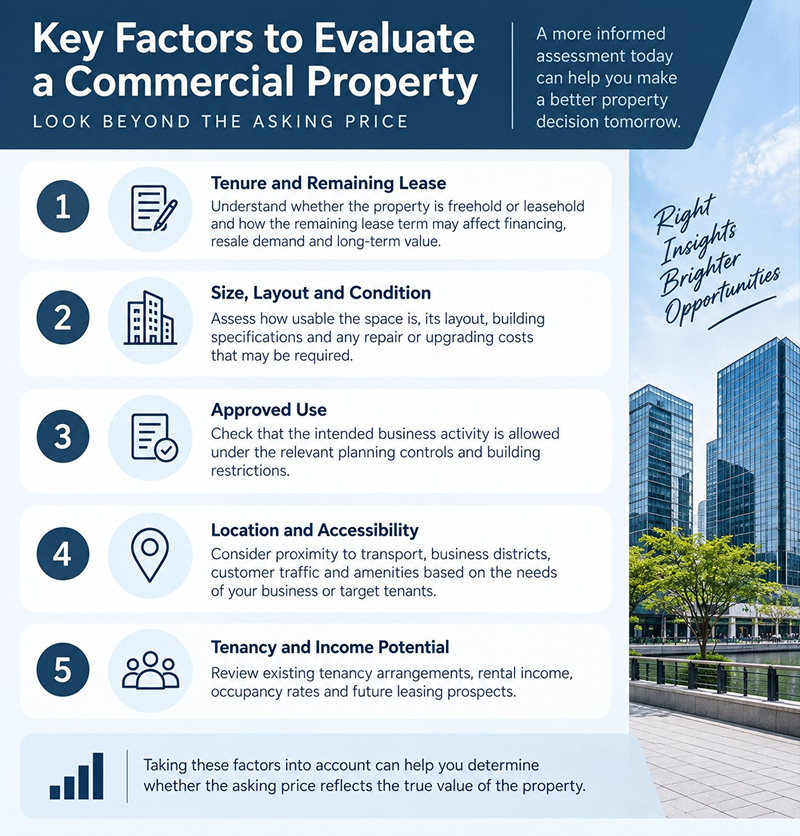
Before deciding whether the seller’s figure is reasonable, you need to understand exactly what you are buying. A practical approach to evaluating a commercial property starts by looking beyond the advertised price at factors such as tenure, configuration, physical condition, and permitted use.
A lower commercial property price does not automatically mean better value if the property has a shorter lease term, needs substantial upgrades, or cannot support your intended business activity. Equally, a higher-priced property may have features that justify a premium over superficially similar alternatives.
Tenure, Remaining Lease and the Ownership Interest You Are Buying
Tenure is one of the first property characteristics you should establish when considering a commercial acquisition. Freehold and leasehold properties offer different ownership profiles, while the remaining lease becomes particularly important when you are considering a leasehold asset.
When deciding how to evaluate a commercial property with a limited lease term, consider how that tenure interacts with financing, future resale demand, and your intended holding period. Financing may also be a consideration, but requirements vary between lenders and should not be treated as a fixed consequence of tenure.
You should also confirm the specific property interest being offered for sale. Buying a strata commercial unit, an entire building, or a property subject to an existing tenancy can involve different ownership and investment considerations.
If you want to check valuation of property against previous sales, check the tenure before assuming that two transaction prices provide a direct comparison. A property sold with a substantially different lease term may require further interpretation before you can use its transaction price as a meaningful benchmark.
Size, Layout, Condition and Building Specifications
Floor area provides a useful starting point for comparison, but to evaluate a commercial property properly, consider how effectively that space can actually be used. Two units with the same stated area may provide very different amounts of practical usable space because of their layout, structural columns, circulation areas, or frontage.
The features that matter most also depend on the type of property you are considering. For retail premises, frontage, visibility, and pedestrian access may matter more. For office space, floor configuration, natural light, and accessibility may matter more. Other commercial premises may depend more heavily on building services, parking, or operational access.
You should also consider what you may need to spend after completing the purchase. A property requiring significant repairs, upgrades, or reinstatement may involve costs not obvious from the headline price. A well-maintained property may require less immediate capital expenditure.
This is why, to evaluate a commercial property, you need to look beyond whichever unit has the lowest price per square foot. Determine whether the properties genuinely offer similar utility, condition, and features before treating their prices as directly comparable.
Approved Use, Location and Suitability for Your Intended Purpose
A commercial property should also be assessed according to whether it can realistically support what you intend to do with it. Premises that appear physically suitable for a particular business may still be affected by approved-use requirements, planning controls, or building restrictions.
If you intend to occupy the property yourself, establish whether it can support your operations. Before committing to premises for a particular business activity, it is also useful to check whether the intended use is permitted, as some changes of use may require planning permission.
If you are buying as an investor, consider the range of businesses that could realistically occupy the premises in future. Assess the location based on the requirements of the intended business use and the occupiers or tenants the premises are likely to attract.
Proximity to transport, business districts, customer traffic, or complementary businesses may support demand, but these factors do not carry the same importance for every type of commercial property.
How a commercial property’s location supports its intended use is something to evaluate before paying a premium. The same address or accessibility feature can matter differently across occupiers, so focus on advantages relevant to likely users.
Understanding how to evaluate a commercial property in this context can help you determine whether a premium reflects genuinely useful advantages from limitations that may affect future use and marketability.
Testing the Asking Price Against Market and Financial Evidence
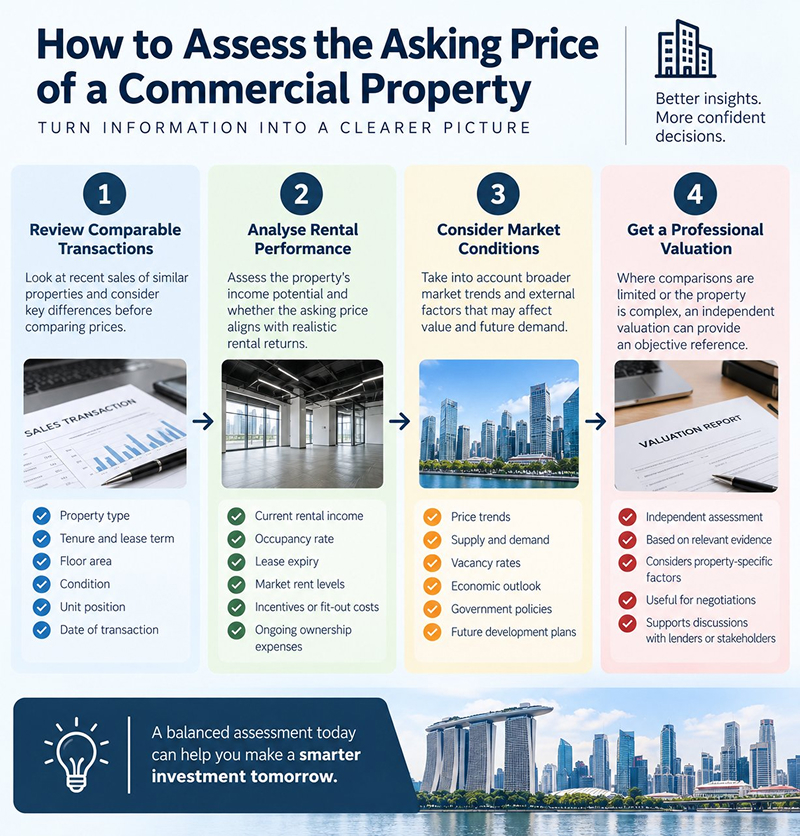
Once you understand the property, you can test the seller’s pricing expectation against market evidence. To evaluate a commercial property against the asking price, consider how advertised figures compare with prices buyers have actually agreed to pay.
Comparable sales, transaction timing, income, and broader market conditions can all provide useful evidence. However, avoid treating any single figure as definitive. Commercial properties often differ enough that you need to consider each comparison in context.
Recent Comparable Transactions and What Makes a Comparison Reliable
Completed transactions involving similar properties can show how to evaluate a commercial property against evidence from actual sales. Sales from the same development or immediate area may be particularly useful, but proximity alone does not make two properties directly comparable.
Look at whether the other transaction involved a similar property type, tenure, lease term, floor area, condition, and unit position. If you are considering a strata commercial property, floor level, frontage, and location within the building may also influence the prices buyers have paid.
A sale completed under unusual transaction conditions or in a materially different market period may not reflect current demand. Older transactions can still be informative where few properties have changed hands, but they should be considered alongside more recent evidence where available.
To evaluate a commercial property using several sales, consider how representative each transaction is rather than relying on an isolated result that sits materially above or below the wider evidence. Singapore’s commercial property prices, rentals, vacancies, and transaction information can provide additional market context.
Current listings help show what other sellers are asking. However, an advertised figure does not reveal what a buyer will eventually agree to pay, so you should not treat listings the same way as completed transactions.
Rental Income, Occupancy and the Investment Case
To evaluate a commercial property as an investment, consider how the proposed price relates to the income the asset can reasonably generate. A seemingly attractive purchase price may become less appealing if rental income is weak, the premises face prolonged vacancy, or a major lease expiry is approaching.
For a tenanted property, review the rent currently being received and how much time remains on the tenancy. The existing rent may be above, below, or broadly in line with current market levels, which can affect how sustainable the future income appears.
A vacant property requires a different assessment. You may need to consider the rent the premises could realistically achieve, tenant demand, how long it may take to secure an occupier, and whether incentives or fit-out works are needed.
To evaluate a commercial property using yield, distinguish how headline gross rental income differs from the income retained after ownership costs. Property tax, maintenance, service charges, vacancy periods, repairs, and future capital expenditure can reduce the net income available to you, so gross yield should not be viewed in isolation.
Where rental performance is particularly important, our rental valuation can provide another reference point when considering the income assumptions associated with the property.
When an Independent Valuation Provides a Clearer Reference Point
You can carry out useful preliminary research yourself, but knowing how to evaluate a commercial property does not mean every asset can be assessed reliably from publicly visible listings and a handful of transactions.
Some commercial properties have few recent sales, while others differ in tenure, tenancy arrangements, physical features, or location, making direct comparisons less straightforward. An independent valuation brings the relevant evidence together so you can consider differences between the subject property and available market references in context.
Our independent commercial building valuation assesses the asset against relevant evidence available at the valuation date. Rather than starting from the seller’s preferred figure, we can consider comparable sales, the property’s individual features, prevailing market evidence, and, where relevant, rental or investment factors.
For a buyer, the practical value is a formal reference for the asking price, not a guarantee that one transaction price is correct. Our reports are used for mortgage purposes, but financial institutions can have their own requirements, so buyers should confirm these with their lender.
Our valuation team includes licensed property valuers from IRAS and members of the Singapore Institute of Surveyors and Valuers (SISV). Our work can complement how to evaluate a commercial property by providing a clearer basis for comparing the asking price with relevant evidence before deciding how to proceed.
Frequently Asked Questions
Is the asking price the same as the market value of a commercial property?
No. To evaluate a commercial property against its asking price, first understand how that figure differs from an assessed market value. The asking price is what the seller is seeking, while a valuation provides a professional opinion based on the property and relevant market evidence. The final transaction price can still differ because of negotiation and the circumstances surrounding the transaction.
Is price per square foot enough to judge whether a commercial property is reasonably priced?
No. Price per square foot can help with an initial comparison, but how to evaluate a commercial property involves more than this one metric. It does not fully account for differences in tenure, layout, condition, floor position, permitted use, or tenancy arrangements.
What should I do if the asking price is much higher than recent transactions?
First, check whether property-specific factors explain the difference, such as a longer lease term, better unit position, stronger tenancy, or superior condition. To evaluate whether a commercial property justifies a premium, examine how those differences compare with the evidence rather than assuming the asking price is automatically too high.
What if there are very few comparable commercial property transactions?
A lack of recent transactions does not automatically mean the seller’s figure is reasonable or unreasonable. To evaluate a commercial property with few comparables, consider how older transactions, nearby comparable assets, rental evidence, and the property’s individual features fit together.
Can an independent valuation help me decide how much to offer?
An independent valuation does not tell you the exact amount you must offer. It can provide a reference point for deciding whether you are comfortable proceeding at the proposed level, whether the evidence supports further negotiation, or whether additional assessment is warranted. Our formal valuation reports are used for purposes including mortgage valuation, but buyers should confirm any lender-specific requirements directly with the relevant financial institution.
Making Your Purchase Decision With Better Pricing Evidence
Determining whether a commercial property’s asking price is reasonable requires more than comparing advertisements or calculating an average price per square foot. A sound way to evaluate a commercial property is to consider how tenure, lease term, layout, condition, permitted use, and location affect what you are actually buying.
Completed transactions can then show how the market has priced similar properties. If you are buying an investment property, occupancy, lease expiry, income potential, and future letting prospects provide another important layer of evidence. Repair costs, ongoing ownership expenses, and restrictions affecting the premises can also change whether an apparently attractive purchase represents suitable value for your objectives.
Ultimately, understanding how to evaluate a commercial property confidently means considering these factors together rather than relying on one headline figure. If relevant evidence supports the proposed price, you can use that information when deciding whether to proceed. If meaningful differences remain, further investigation or valuation may provide greater clarity before you commit.
Contact CKS Property Consultants to discuss the commercial property you are considering, your intended purchase, and the purpose of the valuation. We can provide an independent professional opinion of value and a clearer basis for reviewing the asking price, subject to the relevant purpose and any lender-specific requirements that may apply.

Leroy Toh
Written By
Leroy is currently a Year 3 student progressing into Year 4 at the National University of Singapore, pursuing a degree in Business Administration (Real Estate).

Tan Wei Han
Reviewed By
Wei Han is a Valuer at CKS Property Consultants, graduated from the University of Reading Malaysia with a BSc in Real Estate with Honours, where he built a strong foundation in property valuation, real estate economics and facilities operations.

Copyright © 2024 CKS Property Consultants Pte Ltd