What Should I Expect During the Complete Property Valuation Process in Singapore?
Blogs & Articles / What Should I Expect During the Complete Property Valuation Process in Singapore?

Key Takeaways
The complete property valuation process begins by confirming why you need the valuation, who will use the report, the relevant valuation date, and the property interest being assessed.
Preparing accurate property documents and arranging access early can help prevent avoidable delays.
A professional property inspection is considered alongside legal, planning, occupancy, and market information.
The valuer considers comparable transactions, property characteristics, and other evidence before forming an opinion of market value.
In Singapore, tenure, approved use, planning considerations, and available transaction evidence can influence how a property is assessed.
Introduction
If you are arranging a property valuation for the first time, you may wonder what happens after you contact a valuer and how involved you need to be. The complete property valuation process involves considerably more than inspecting a building and assigning a figure.
From the initial enquiry to the final report, you may need to confirm the purpose, prepare documents, arrange access, and respond to requests for clarification. Understanding the complete property valuation process helps homeowners, investors, companies, and institutional stakeholders prepare efficiently and know what to expect.
The process can differ by property type, ownership or tenancy arrangements, and the party relying on the report. A residential real estate valuation may be relatively straightforward, while a commercial building, industrial facility, or corporate portfolio may require broader market research and financial analysis.
What Do I Need to Prepare Before My Property Valuation?
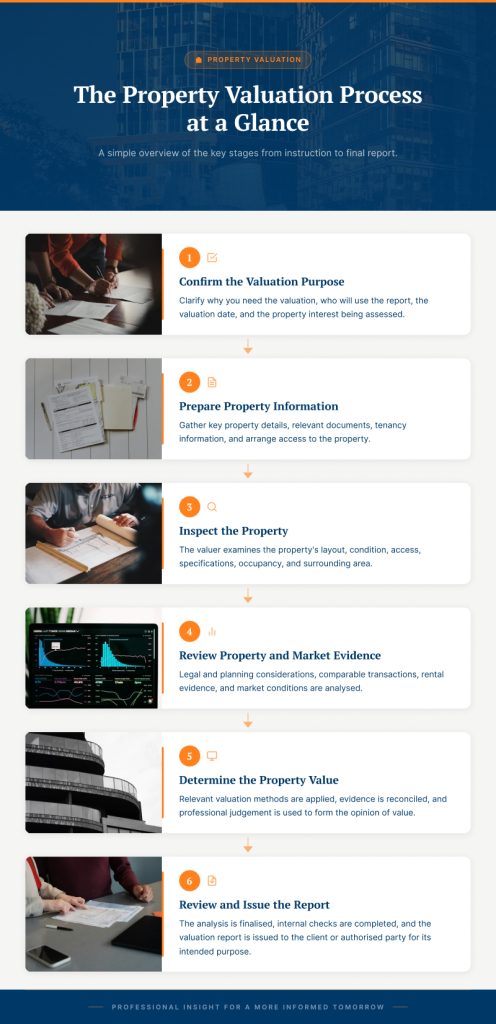
Good preparation can make the complete property valuation process more straightforward by giving the valuer enough information to establish the scope, fee, timeline, and requirements before inspection and analysis begin. It also lets you flag deadlines, access restrictions, or unusual property characteristics early.
Confirming Why You Need the Valuation
First, confirm why you need the valuation, who will rely on the report, and the relevant valuation date. A report prepared for financing, a sale, probate, litigation, financial reporting, or a feasibility study may involve different assumptions and reporting considerations. Feasibility work may also assess redevelopment potential, planning constraints, market demand, and projected use. At CKS, we undertake valuations for purposes including conveyancing, mortgage, fire insurance, and financial reporting.
You will also need to confirm whether you are valuing the entire property or a specific ownership share, leasehold interest, or portfolio component. Clarifying this at the beginning of the complete property valuation process helps ensure the report is prepared for the correct purpose and interest.
Sharing the Initial Property Details
The address, property type, tenure, floor area, occupation, and tenancy status give the valuer an initial picture of the assignment. Providing these details early gives the valuer a clearer starting point for the complete property valuation process.
Commercial, industrial, and portfolio valuations may require further information about approved use, rental income, and building specifications. In Singapore, tenure can be particularly relevant because properties may have different remaining lease periods or be held on a freehold basis. You should also flag major alterations, restricted areas, redevelopment proposals, or complex ownership arrangements.
Receiving the Scope, Fee, and Expected Timeline
Before work proceeds, you should know what the instruction covers, whether an inspection is required, and what type of report will be prepared. Fees and completion times can vary based on the asset, complexity, available information, and required research. Understanding these requirements helps you know what to expect from the complete property valuation process before the assessment begins.
The engagement terms may also identify intended users, the valuation date, assumptions, and exclusions. Reviewing these matters beforehand can prevent misunderstandings, particularly when a lender, auditor, lawyer, or other third party will rely on the report.
Preparing the Required Property Documents
Relevant records may include title information, floor plans, tenancy agreements, property tax records, sale documents, and renovation details. The documents required during the complete property valuation process depend on the property and valuation purpose.
For income-producing assets, you may also need to provide tenancy schedules, lease renewal options, service charge information, and operating records. Probate, litigation, and corporate assignments can require additional legal or financial information.
Arranging Access to the Property
If the property is occupied, you may need to coordinate with tenants, managing agents, security personnel, or other representatives before the valuer arrives.
For larger or operationally complex sites, having someone familiar with the property available can help answer factual questions. Also raise restricted operating hours, safety procedures, or security clearance early.
What Happens When the Property Is Examined?
Once the valuer has the preliminary information, they can inspect the physical asset and confirm key details. The inspection is an important stage of the complete property valuation process, but it is considered together with documentation, planning information, and market evidence.
A standard apartment may require a relatively focused assessment, whereas a tenanted commercial property can require closer consideration of leases, rental income, occupancy, and investment characteristics.
Conducting the Property Inspection
During the visit, the valuer records visible characteristics such as layout, condition, access, building specifications, and surroundings. The factors receiving the greatest attention will differ between residential, retail, commercial, and industrial properties.
The inspection is for valuation purposes, not a structural or technical building survey. Where defects or inaccessible areas could affect the assessment, the valuer may record the limitation or request additional information.
Reviewing Legal, Planning, and Occupancy Information
What the property can legally be used for may be as relevant as its physical characteristics. The valuer may therefore consider tenure, title restrictions, approved use, planning controls, and current occupancy.
For Singapore properties, the URA Master Plan guides land use and development across Singapore. Depending on the property and proposed activity, a change of use may require planning permission.
For tenanted properties, rental amounts, lease expiry dates, renewal provisions, and other lease terms may also influence the analysis.
Resolving Missing or Inconsistent Details
A difference between a floor plan and physical layout, or between tenancy information and actual occupation, may need clarification before the report is completed.
Where information cannot be verified, the valuer may make an assumption, state a limitation, or request further evidence. Prompt responses can help avoid delays in completing the report and supporting analysis.
Gathering Relevant Market Evidence
The valuer considers recent sales, rental evidence, investment yields, and prevailing market conditions where relevant. For HDB flats, recent HDB resale statistics can provide useful public transaction context when the property and available evidence belong to the same market segment. For private residential properties, other transaction sources may be more relevant.
Not every transaction is equally useful. Location, tenure, size, condition, use, and transaction timing can make one property more relevant than another. The valuer may examine comparable transactions, but differences from the subject property still need careful consideration.
Market research is therefore an important part of the complete property valuation process, particularly when available transactions differ substantially from the subject property. For example, a nearby sale with a much larger floor area or very different remaining lease may carry less weight than a transaction that more closely matches the subject property’s characteristics. Asking prices can provide context, but they are not the same as completed transactions, so the valuer weighs each source for relevance and reliability.

Selecting and Applying the Valuation Approach
Choosing an appropriate methodology is another important stage in the complete property valuation process, as no single method suits every property. Comparable sales can provide useful evidence for residential properties, while income-producing assets may require rental and yield analysis. Development sites and specialised assets may require other approaches.
For a commercial building valuation, the property’s income characteristics, lease position, and investment considerations may become more significant than for an owner-occupied residential unit.
Where appropriate, more than one approach can help test whether the conclusion is reasonable, particularly where relying on a single method would not fully reflect the property’s characteristics or available evidence.
How Does the Complete Property Valuation Process Lead to a Final Value?
Once the information has been gathered, the valuer must interpret the available evidence and determine how relevant it is to the subject property.
Professional judgement matters because apparently similar properties may differ in tenure, location, condition, floor area, lease arrangements, or other characteristics that affect value.
Reconciling the Available Evidence
During this stage of the complete property valuation process, the valuer considers which properties are genuinely relevant and how their characteristics differ from the property being assessed.
Adjustments may be necessary for size, tenure, condition, floor level, lease terms, location, or specifications. The final assessment therefore reflects a reasoned reconciliation rather than a simple average.
Recording Assumptions and Limitations
Some information may not be independently verifiable, while certain areas may not be accessible. Relevant assumptions or limitations should be recorded so the intended user understands the basis of the valuation.
This is particularly important when the report will be relied upon for a financial, corporate, or legal purpose.
Forming the Opinion of Value
The resulting value reflects the property, relevant evidence, and valuation date. It is a professional assessment, not a guaranteed sale price.
Actual outcomes can be affected by negotiation, financing, timing, buyer circumstances, and market changes. The final market value should therefore be read together with the assumptions and valuation basis.
Completing Internal Review and Quality Checks
Before issuing the report, calculations, property details, evidence, and report wording may undergo internal checks. Complex or high-reliance assignments may require additional review.
At CKS, our internal property valuation system supports our paperless e-valuation reporting process. For clients, this means the administrative and reporting workflow can be handled digitally, including issuing e-valuation reports, while professional judgement remains central to the final opinion.
Preparing and Issuing the Valuation Report
The final stage of the complete property valuation process brings the analysis, evidence, assumptions, and opinion of value together in the valuation report. It may also contain photographs, plans, tenancy information, market commentary, or appendices.
Once the analysis and necessary internal review are complete, the report can be issued to the client or authorised party for its stated purpose.
What Should I Do After Receiving the Report?
Receiving the report does not necessarily mark the end of the complete property valuation process, particularly if factual information needs clarification or relevant new information becomes available.
Your first step should be to check that the factual information about the property is correct. You can also seek clarification if you do not understand the methodology, assumptions, or evidence behind the conclusion. Any amendment to the valuation should be supported by relevant corrected or new information, not a preferred figure.
Checking the Property Details and Ask for Clarification
Check the address, floor area, tenure, occupancy, and other factual information recorded in the report. Material inaccuracies should be raised promptly because they may affect the analysis.
A minor correction may have no effect, while a significant discrepancy involving floor area, tenancy, or ownership could require further consideration.
If you are unsure why particular evidence was used or how an assumption affected the assessment, you can ask the valuer for clarification.
A value should only be reconsidered where relevant new or corrected evidence provides a proper basis for doing so.
Providing Material New Information
A newly supplied tenancy agreement, approved plan, or title record could affect the assessment if it changes an important fact about the property.
The valuer will assess whether the new information affects the original analysis and whether the report requires clarification, amendment, or reassessment.
Using the Report for Its Intended Purpose
A valuation prepared for one purpose may not satisfy the requirements of another. A report prepared for internal planning, for example, may not meet a lender’s or auditor’s requirements.
Check who can rely on the report and whether the receiving party has requirements relating to valuation basis, format, or appointed valuers.
Knowing When an Updated Valuation May Be Required
An older valuation may become less relevant when the property or surrounding market changes. New leases, prolonged vacancies, substantial renovations, planning changes, or significant market movements can affect an earlier assessment.
An external institution may also have requirements concerning the age of an acceptable valuation report, so confirming these requirements early can help you determine whether an existing report remains suitable or a fresh valuation is needed.
Will the Valuation Process Differ for My Type of Property?
The main stages of the complete property valuation process remain broadly consistent, but the information required and depth of analysis can vary considerably.
Residential Property Valuations
For residential properties, the complete property valuation process commonly considers location, tenure, floor area, condition, and recent transaction evidence. Landed properties, unusual layouts, or substantial alterations may require further investigation.
If you are arranging a home valuation, the reason for obtaining it can also influence the instruction. CKS undertakes valuations for purposes including sale and purchase, mortgage, and other property-related requirements.
Commercial, Retail, and Industrial Valuations
Income can become more important when a property is leased. Rental terms, occupancy, approved use, specifications, and investment considerations may all need closer analysis.
Approved use can also matter for certain properties in Singapore. URA’s guidance on changing a property’s use covers when planning permission may be required. Where use affects marketability or redevelopment potential, this can become relevant to the valuation.
Portfolio and Corporate Valuations
When several assets are assessed together, information needs to be coordinated across the portfolio and applied consistently at the relevant valuation date.
Finance teams, property managers, auditors, and site representatives may need to contribute information. Different property types may require different valuation approaches, so consistent information and valuation dates matter when you consider results across the portfolio.
Rental, Probate, Litigation, and Financial Reporting Assignments
The reason you need a valuation can affect the investigation and reporting requirements. A rental valuation, for instance, focuses on rental value rather than simply establishing capital value.
Probate, litigation, and financial reporting work may involve historical valuation dates or particular reliance requirements, requiring additional documentation or coordination with other professional advisers.
Conclusion
Understanding the complete property valuation process helps you know what to prepare, what the valuer will assess, and what to check once the report has been issued. From gathering information to inspecting the property, analysing market evidence, and reviewing the final report, each stage contributes to a professional opinion supported by the available facts and evidence.
CKS Property Consultants’ valuation team includes appraisers licensed by IRAS and accredited by the Singapore Institute of Surveyors and Valuers (SISV). Combined with our experience across residential, commercial, industrial, and retail properties, this gives you access to professional valuation expertise across different property types and valuation purposes.
If you require an independent valuation, you can approach CKS Property Consultants to confirm the appropriate scope, documentation requirements, and next steps for your property.
Frequently Asked Questions
Can a property valuation begin before all documents are available?
Work may begin once essential information has been provided, although missing records can delay completion or require assumptions. The valuer can confirm which documents are needed at the outset.
What happens if parts of the property cannot be inspected?
The valuer may record the restriction and decide whether the available information is sufficient. Significant limitations can require another visit, supporting evidence, or a narrower scope.
Can a valuation report be used for a different purpose?
Generally, the report should only be relied upon for its stated purpose and by its intended users. A different purpose can involve different reporting or reliance requirements.
Can the value change if I provide new information?
Potentially. Reliable new information can affect the assessment if it materially changes the valuer’s understanding of the property or evidence considered.
Does every property follow exactly the same complete valuation process?
No. The complete property valuation process follows similar broad stages, but the work required depends on the property type, purpose, complexity, and available evidence.

Leroy Toh
Written By
Leroy is currently a Year 3 student progressing into Year 4 at the National University of Singapore, pursuing a degree in Business Administration (Real Estate).

Tan Wei Han
Reviewed By
Wei Han is a Valuer at CKS Property Consultants, graduated from the University of Reading Malaysia with a BSc in Real Estate with Honours, where he built a strong foundation in property valuation, real estate economics and facilities operations.

Copyright © 2024 CKS Property Consultants Pte Ltd